The Week-Two Wobble: Judging New Ink Before You Book the Laser
There’s a particular kind of silence that fills a British bathroom around day ten of a tattoo heal. You’re standing under a bulb that makes everything look grey, phone in hand, comparing your healing piece to the crisp version your artist posted on Instagram. Twenty minutes ago you loved it. Now you’re convinced the linework is wonky, the black looks washed out and you’ve ruined your arm forever.
Welcome to the week-two wobble. It’s common, it’s unpleasant and it is not a diagnosis. Most of the time you are not looking at a bad tattoo. You’re looking at a healing wound under rubbish lighting, through a camera lens that has sharpened every bit of texture. The two-week itch is a feeling, not a deadline for booking laser.
Why new ink stops looking like the stencil
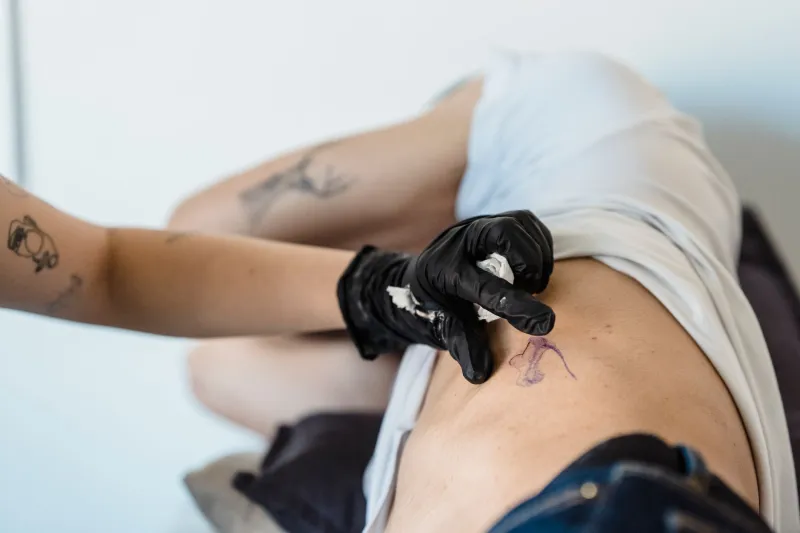
A tattoo is controlled trauma. The ink sits in the dermis while the top layers of skin do their best to repair themselves. That process brings inflammation, dryness, flaking, scabbing and a whole lot of change. Lines can look patchy. Colour can go milky. Black can appear grey or soft at the edges. Shading that looked smooth in the studio can seem muddy once the skin starts to settle.
None of that is the final result. Surface healing usually takes a couple of weeks, but the deeper layers keep settling for longer. Judging a tattoo on day seven is like judging a cake while it’s still in the oven. You’re allowed to peek. You’re not allowed to declare it ruined.
Your bathroom mirror is not a colour-accurate preview
British winter daylight is not exactly generous. Add an overhead bulb, a phone camera and a body part held at an awkward angle and you’ve got a perfect storm for distortion. Overhead lighting casts shadows that make linework look uneven. Phone cameras sharpen texture, boost contrast and turn every flake into a crisis. Swelling changes the shape of the skin, especially on ankles, ribs, fingers and anywhere that bends.
Before you spiral, try this: take a photo in indirect daylight, from the same distance and angle, and look at it on a normal screen. Better still, ask someone who isn’t emotionally invested and hasn’t been staring at it for ten minutes. If they say it looks like a healing tattoo, believe them.
When to message your artist — and how to do it
Not every wobble needs an email. Some do. If you’ve got spreading redness after the first few days, heat, pus, a fever, increasing pain, blistering or a rash that’s climbing away from the tattoo, contact your artist or a medical professional. Those are not ordinary healing quirks.
For everything else, wait until you’ve got a clear question. Use the studio’s preferred channel, include your booking date and artist’s name, and attach a few clear photos in daylight. Don’t send a blurry close-up with the caption “is this normal???” at midnight. Try: “Hi, I’m on day nine of this piece and the colour looks patchy in the middle. Does this look within normal range for this stage?”
Artists would much rather answer an early question than discover you’ve been quietly fuming for three weeks. What they don’t love is a public pile-on before you’ve spoken to them. If something’s gone wrong, give the studio a chance to respond. Most will.
Touch-up policies: the honest version
Most UK studios offer touch-ups within a set window, but the details vary. Free touch-ups usually cover artist-related issues — patchy colour, a line that healed lighter than expected, a small area that didn’t take. They rarely cover neglect. If you picked a scab, swam in a chlorinated pool, baked in the sun or ignored the aftercare sheet, expect to pay for the fix.
A touch-up is not a cover-up. A cover-up is a new design over an old one, and no sensible artist will cover fresh ink before it has fully healed. Laser is a separate process too, and it also waits until the skin has settled. Ask about the policy before you book, get it in writing if you’re unsure, and don’t assume every studio works the same way.
The checklist: ordinary weirdness vs something worth flagging
Ordinary healing weirdness: itching, flaking, dry patches, milky haze, mild redness around the edges in the first few days, tightness, slight swelling, scabbing and patchy colour. It can look worse before it looks better.
Worth flagging: spreading redness, heat coming off the tattoo, swelling that gets worse after day three to five, pus, a foul smell, fever, streaking, hives, blistering or pain that increases rather than eases. When in doubt, ask. You won’t be the first nervous client and you won’t be the last.
If it’s healed and you still hate it
Give it time. A fully settled tattoo can take four to six weeks, sometimes longer. If you still don’t love it once the skin is calm, talk to your artist about a rework, a small addition or a consultation for a cover-up. Bring references, be honest and don’t rush into laser because a scabby Tuesday made you panic.
At Studio 69, we’ve seen enough week-two wobbles to know they pass. Keep it clean, keep it moisturised, keep it out of the sun and keep the drama for your group chat. Your tattoo will look more like itself soon enough.